|

The term "productivity” may be defined as the ratio of an output measure to one or more of the inputs associated with that output. The most commonly used productivity index is output per unit of labor input, generally called labor productivity. The historical increase in labor productivity is important because it forms the primary component of the long-term increase in national product per person, which is to say the average income levels and standards of living for the population as a whole. To say that labor productivity is the "primary component” of long-term economic growth, however, is not to identify the causal mechanisms of the growth process in any simple way. Labor productivity reflects not just labor's effort but also other factors, including the state of technology, capital per worker, the efficiency of management, the pace of operations, and changes in the composition of the workforce. A variety of alternative input and output measures have been developed in productivity studies as part of the effort to understand the sources of historical productivity change.

Productivity concepts have come in for considerable attention and debate in recent years as part of the national discussion about appropriate indicators of economic performance. Despite the apparent simplicity of the core concept, virtually every term in a productivity calculation requires some adjustment to make the resulting ratio meaningful in economic terms. Long-term productivity studies typically divide a measure of aggregate output (such as gross domestic product (GDP)) by an index of total worker-hours. 1 The computation of worker-hours entails defining which members of the population were in the labor force, and hence contributing to production, and estimating the average hours worked per year by each member of the labor force. The adjustment for labor-hours is appropriate, because U.S. economic growth has been characterized (as in other countries) by a long-term decline in the average work week, from more than sixty hours in the mid-nineteenth century to the forty hours that became standard in the 1930s. In the face of such large historical change, total hours worked seems a better measure of labor input than simply counting the number of workers. Such adjustments can make a large difference during times of rapid change in the condition of labor. For example, between 1913 and 1950, real per capita GDP grew at 1.61 percent per year, according to Angus Maddison, but GDP per hour worked grew during the same period by 2.48 percent per year, more than 50 percent faster (Maddison 2001, pp. 186 and 352). The difference is explained by declines in the average workweek and in the share of the population in the labor force.
Table Cg265–272
Table Cg273–280
Table Cg281–291 report such aggregate measures of labor productivity for extended overlapping historical periods. An aggregate output measure such as GDP is a value-added concept, which means that intermediate purchases of goods and services have been "netted out.” Current-dollar GDP has the convenient property that it is equal to current-dollar value added summed across all industries. To convert current-dollar productivity into a "real” productivity measure, however, one must deflate them by an index of the general price level, thus introducing all of the "index number problems” that arise when relative prices change over the course of time. Thus, just as with price indexes, aggregate productivity indexes have a "base year,” which must be changed from time to time in order to reflect changing relative prices and the changing composition of GDP. Because the choice of base year affects the trend, it is not advisable to join productivity series from Table Cg265–272
Table Cg273–280
Table Cg281–291 by splicing them together using the overlap years. The three graphs in Figure Cg-C suggest that older series deviate increasingly from newer ones, the farther removed they are from the original base year. 2 For this reason, linking them at the endpoints is risky, but one may reasonably use different base-year series to compare rates of productivity growth between one historical period and another.
For various reasons, many analysts prefer to work with productivity aggregates that are not quite as broad as GDP. The measurement of labor inputs in the farm sector is particularly difficult because American farms have used part-time and unpaid family labor extensively. Hence, Table Cg265–272, Table Cg273–280 report productivity series separately for the farm and nonfarm sectors. Because measuring output accurately in government and nonprofit activities is generally difficult, the more recent data from the Bureau of Labor Statistics report separate series for the "business sector” and the "nonfarm business sector” ( Table Cg281–291). Similarly, it is often argued that output is imperfectly measured in the financial sector, giving rise to a productivity series for "nonfinancial corporations” ( series Cg286). Indeed, some argue that output measures are inaccurate in the service sectors generally, preferring to focus on manufacturing ( series Cg281). Whether for measurement reasons or "real” reasons, one finds that observed productivity trends and fluctuations differ dramatically among these various indexes. 3

Productivity may be calculated for other inputs besides labor, most often capital. "Capital” in such ratios refers to an aggregation of past investments in plant and equipment, adjusted for depreciation (that is, wear and tear, deterioration, and obsolescence). Although "capital productivity” is much less familiar than labor productivity, historical series of this index do show interesting trends and fluctuations, reflecting changes in the effective utilization of the capital stock. For example, series Cg269 shows that after a long period of relative stability, capital productivity jumped upward in the 1920s. After declines during the Great Depression of the 1930s, the upward trend continued at least until the 1960s, reflecting an increase in the hours of operation in industrial plants, the result in turn of lower costs for electric lighting and power (Foss 1984). The primary purpose for incorporating capital into the analysis, however, is to allow computation of total factor productivity (TFP), the ratio of output to a weighted index of capital and labor inputs. 4 In the modern literature on theories of economic growth, the seminal contribution was Solow (1957), who proposed that aggregate output could usefully be interpreted in terms of an aggregate "production function,” as follows:

where Q is output, K is capital, L is labor, and the subscripts refer to the time period of observation. If the production function F is characterized by constant returns to scale, and if shifts in this production function (represented by the parameter A) are "Hicksian neutral” (that is, the shifts do not affect the relative productivities of capital and labor), then the growth of output may be decomposed into separate contributions from capital, from labor, and from shifts of the aggregate production function, as follows:
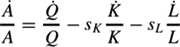
where s
K and s
L are the elasticities of output with respect to capital and labor, respectively (typically approximated by the share of the factor in total product), and the symbol

refers to the percentage growth rate of the variable. In this formulation, the shift variable A is called total factor productivity, and

is the percentage growth rate of total factor productivity. 5
TFP is commonly identified with "technological progress,” but as Hulten makes clear, this usage is generally inappropriate (Hulten 2001). At best, TFP is measured only as a residual and, as such, includes conceptual or empirical errors throughout the analysis – a "measure of our ignorance,” to quote Moses Abramovitz's famous phrase. But even if all of the inputs and outputs were accurately measured, conceptually TFP represents only costless improvements in the way inputs are transformed into real output. New technologies that result from investments in research and development (R&D) are appropriately viewed as forms of capital, as are improvements in the quality of labor that result from time devoted to education or training. Improvements in the organization of production or in the institutional arrangements of society would also be reflected in the residual.
Further, it is by no means clear that the assumption of neutrality between capital and labor is historically appropriate. Economic historians often portray technologies as progressing along "trajectories” of historical learning, which may have pronounced factor-saving biases (for examples, see David 1975; Rosenberg 1976). "Technological change” can take the form of augmenting the effective resource supplies available to the economy – land, minerals, or capital, as well as labor. In such cases, the pace of factor accumulation would itself be influenced by technology. Taking into account interactions between technological change and factor accumulation undermines the very distinction that this framework attempts to delineate. 6
In response to these conceptual ambiguities, many researchers have set out to refine the measures of inputs into the aggregate production function, to reflect improvements in the quality of capital and labor, and changes in the utilization of the capital stock. Jorgenson and Griliches advanced the view that careful measurement of the relevant variables should cause the Solow residual to disappear entirely (Jorgenson and Griliches 1967). Reflecting the insights of the so-called New Growth Theory on the endogeneity of technological change (associated with Romer), subsequent studies have attempted to incorporate R&D spending directly into the growth accounting analysis, though with limited success owing to the absence of an observable knowledge "asset” and an associated income stream (Romer 1986; Griliches 1988). By elaborating and expanding the definitions of inputs into the production process, studies have indeed succeeded in reducing the size of the Solow residual as an explanatory factor in productivity growth accounting. In general, however, this research subjects the raw data in the national accounts to a substantial amount of refinement; hence, it does not lend itself to compilation of basic series in a reference work (for examples, see Jorgenson, Gollop, and Fraumeni 1987; Jorgenson and Stiroh 2000).

Since 1889, labor productivity in the United States has grown at an average annual rate in excess of 2 percent per year. The pace of this growth, however, has by no means been uniform over the entire period. Figure Cg-C displays the three major sets of productivity estimates for the nonfarm economy. The first of these shows distinct productivity acceleration after World War I. The third shows a marked deceleration in the early 1970s. Angus Maddison presents the following periodization (Maddison 2001, p. 352):
| 1870–1913
|
1.92 percent
|
| 1913–1950 |
2.48 percent |
| 1950–1973 |
2.77 percent |
| 1973–1998 |
1.74 percent |
Such comparisons are extremely sensitive to the choice of end dates. Hansen conducts a systematic econometric test for the date at which a structural change occurred in productivity growth, concluding that such a break in the trend had almost certainly taken place by 1980; the verdict for 1973 is statistically less certain (Hansen 2001). For end dates such as 1978 to 1995, the productivity slowdown would be even more dramatic, falling to less than 1.50 percent per year over this period.
The labor productivity acceleration after World War I was also associated with an acceleration in total factor productivity growth ( series Cg270 and series Cg272), ushering in the era that Gordon refers to as the "One Big Wave” of American economic growth (Gordon 1999). Early growth-accounting studies (such as Abramovitz 1956; Solow 1957) found that most growth in labor productivity was not attributable to increases in capital per worker, giving rise to the stylized fact that the primary source of economic progress was not investment but technological change. Abramovitz and David emphasize, however, that this generalization fits the twentieth century much better than the nineteenth century (Abramovitz and David 2000). In their account of American economic history, changes in the proximate sources of growth were driven by a deep shift in the character of technological change from one century to the next, from primary reliance on physical resources and tangible capital in the nineteenth century to a much greater use of human and intangible forms of capital (such as knowledge generated by R&D) in the twentieth century. 7
This analysis makes the slowdown in productivity growth beginning in the 1970s all the more puzzling. The TFP residual virtually disappeared during this period, but the proposition that the pace of technological change came to a standstill at this historical point scarcely seems plausible ( series Cg287–291). As Professor Solow put it in an oft-quoted comment: "We can see the computer age everywhere except in the productivity statistics.” Understanding this "productivity paradox” has been one of the central preoccupations of economics in recent years. Many proposed explanations deal with compositional issues and measurement biases. As one may confirm by inspection of Table Cg281–291, the productivity slowdown is less pronounced in manufacturing than in the business sector as a whole or in nonfinancial corporations. The detailed series in Table Cg292–296
Table Cg297–301
Table Cg302–307
Table Cg308–313
Table Cg314–324
Table Cg325–335
Table Cg336–340
Table Cg341–345 show a great range of productivity experience among specific industries. In general, however, the industry tables confirm that productivity growth in recent years has been substantially greater in most manufacturing industries than in service industries such as electric and gas utilities or the postal service ( Table Cg336–340
Table Cg341–345). Some studies find zero or even negative productivity growth in large sectors such as construction, insurance, banking, and health. Because output is poorly measured in these sectors, it is sometimes suggested that the productivity slowdown is largely attributable to the growth of the relative size of that portion of the economy for which objective measures of productivity are inadequate. But there are good reasons to believe that the productivity slowdown has been real, however uncertain its locus and magnitude may be. For one thing, many service industries have recorded large productivity gains in the past, and some, such as railroad transportation and telephone communications ( series Cg341–342), have been well above the average even in recent decades. Measurement biases, including the failure of price indexes to account fully for quality change, improvements in speed and convenience, and so on, have always posed problems for productivity accounting, but it has not been shown that these problems became more severe during and after the 1970s than in earlier times. For another thing, the assignment of productivity change to sectors and industries is often arbitrary. As the measurement of productivity in computers and information technology has become more sophisticated – replacing mere machine counts with "hedonic” indicators reflecting improvements in speed, memory, and capability – the allocation of productivity between the computer-producing and the computer-consuming sectors may well be altered. Further, the rise of temporary employment services and other specialized service firms means that many tasks formerly carried out as part of "manufacturing” have now been shifted to other sectors, blurring comparisons of sector-specific productivity rates. Another class of explanations attributes the slowdown to the completion of Gordon's "One Big Wave,” a cluster of productivity-enhancing innovations and structural shifts that diffused through the economy between the 1920s and the 1970s. On this view, time lags between the invention of new technologies and their major impact on productivity are only to be expected because both technology and its utilization often require organizational and institutional restructuring before its potential can be realized. Paul David has proposed an analogy between the computer and the electrification of manufacturing, for which the basic technological foundations had been in place for more than a generation prior to its dramatic impact on productivity in the 1920s (David 1990). Both of these would qualify as examples of general-purpose technologies, whose improvement and adoption typically require an extended period of learning and adaptation (Bresnahan and Trajtenberg 1995; Helpman 1998). According to this perspective, the rapid pace of change in computer and information technologies has, if anything, made it more difficult for business firms to adapt their organizations and personnel so as to take advantage of the potential of the new technologies to raise productivity. But a strong productivity effect should ultimately occur, and may have begun in the latter half of the 1990s (see series Cg281–286 and the industry data in Table Cg292–296
Table Cg297–301
Table Cg302–307
Table Cg308–313
Table Cg314–324
Table Cg325–335
Table Cg336–340
Table Cg341–345). In the decade of the 1920s, technological transformations interacted with significant changes in the labor market – most notably, the sharp increase in the wages of unskilled labor associated with the end of mass European immigration – to accentuate both the diffusion of electric power and its deployment as a productivity-raising tool. A similar conjunction may have occurred in the late 1990s, when extremely tight labor market conditions prompted firms to speed up the process of adaptation to new computer and information technologies, restoring the growth of labor productivity after two decades of stagnation. Perhaps the best test among competing interpretations of the slowdown will be whether or not the increased rate of productivity change persists in the first decade of the new millennium.
Figure Cg-C.
Nonfarm labor productivity: 1889–2000
Sources

Abramovitz, Moses. 1956. "Resource and Output Trends in the United States since 1870.” American Economic Review 46 (May): 5–23.
Abramovitz, Moses. 1993. "The Search for the Sources of Growth: Areas of Ignorance, Old and New.” Journal of Economic History 53 (June): 217–43.
Abramovitz, Moses, and Paul A. David. 2000. "Growth in the Era of Knowledge-Based Progress.” In Stanley L. Engerman and Robert E. Gallman, editors. The Cambridge Economic History of the United States. Cambridge University Press.
Bresnahan, Timothy, and Manuel Trajtenberg. 1995. "General Purpose Technologies.” Journal of Econometrics 65: 83–108.
David, Paul A. 1975. Technical Choice, Innovation and Economic Growth. Cambridge University Press.
David, Paul A. 1990. "The Computer and the Dynamo.” American Economic Review 80 (May): 355–61.
Foss, Murray. 1984. Changing Utilization of Fixed Capital: An Element in Long-Term Growth. American Enterprise Institute for Public Policy Research.
Gordon, Robert J. 1999. "U.S. Economic Growth since 1870: One Big Wave?” American Economic Review 89 (May): 123–8.
Griliches, Zvi. 1988. "Research Expenditures and Growth Accounting.” In Zvi Griliches, editor. Technology, Education and Productivity. Blackwell.
Hansen, Bruce E. "The New Econometrics of Structural Change: Dating Breaks in U.S. Labor Productivity.” Journal of Economic Perspectives 15 (Fall): 117–28.
Helpman, Elhanan, editor. 1998. General Purpose Technologies and Economic Growth. MIT Press.
Hulten, Charles R. 2001. "Total Factor Productivity: A Short Biography.” In Charles R. Hulten, Edwin R. Dean, and Michael J. Harper, editors. New Developments in Productivity Analysis. Studies in Income and Wealth, Volume 63. University of Chicago Press.
Jorgenson, Dale W., and Zvi Griliches. 1967. "The Explanation of Productivity Change.” Review of Economic Studies 34 (July): 349–83.
Jorgenson, Dale W., Frank M. Gollop, and Barbara M. Fraumeni. 1987. Productivity and U.S. Economic Growth. Harvard University Press.
Jorgenson, Dale W., and Kevin J. Stiroh. 2000. "Raising the Speed Limit: U.S. Economic Growth in the Information Age.” Brookings Papers on Economic Activity, issue 2: 125–211.
Kendrick, John W. 1961. Productivity Trends in the United States. Princeton University Press.
Kendrick, John W. 1973. Postwar Productivity Trends in the United States, 1948–1969. Columbia University Press.
Kendrick, John W. 1976. The Formation and Stocks of Total Capital. Columbia University Press.
Maddison, Angus. 1991. Dynamic Forces in Capitalist Development. Oxford University Press.
Maddison, Angus. 2001. The World Economy: A Millennial Perspective. Development Centre of the Organisation for Economic Co-Operation and Development.
Nelson, Richard R. 1964. "Aggregate Production Functions and Medium Range Growth Projections.” American Economic Review 54 (September): 575–606.
Romer, Paul M. 1986. "Increasing Returns and Long-Run Growth.” Journal of Political Economy 94: 1002–37.
Rosenberg, Nathan. 1976. Perspectives on Technology. Cambridge University Press.
Solow, Robert M. 1957. "Technical Change and the Aggregate Production Function.” Review of Economics and Statistics 39 (August): 312–20.
Steindel, Charles, and Kevin J. Stiroh. 2001. "Productivity: What Is It, and Why Do We Care about It?” Business Economics (October): 13–31.
......................................
| 1. |
Standard references are Kendrick (1961, 1973) for U.S. historical data and Maddison (1991, 2001) for comparative international figures.
|
| 2. |
|
| 3. |
A useful review of alternative labor productivity concepts and their recent trends may be found in Steindel and Stiroh (2001).
|
| 4. |
The Bureau of Labor Statistics refers to "multifactor productivity,” but these terms are interchangeable.
|
| 5. |
A useful analytical history of this concept is Hulten (2001).
|
| 6. |
For elaboration on these points, see Nelson (1964) and Abramovitz (1993).
|
| 7. |
For estimates of the stock of these unconventional forms of capital, see Kendrick (1976).
|
|





 Top
Top 
