|

Although elections are not a sufficient condition for democracy, competitive elections are necessary for, and often the most visible evidence of, the operation of democratic governments. 1 Certainly, in the United States, competitive elections signal the degree to which American government operates democratically. Nonetheless, the evolution of elections in America and the impact of these elections on the operation of American political institutions yield a story that occasionally raises questions about the success of the grand American experiment. The involvement of state and federal courts in settling the presidential election of 2000 certainly challenged the belief that elections and electoral rules settle all political disputes. But despite these shortcomings, America remains the most visible example worldwide of how democratic elections operate. 2
This chapter summarizes American electoral history from its immediate postcolonial days through the end of the twentieth century. In doing so, it explores the determinants of many historical patterns and offers a brief review of the interactions between electoral outcomes and other political developments. The principal sections of this essay detail the expansion of the voting franchise, its exercise by the mass public, and its impact on the operation of the American national government. The final section provides a picture of the American electorate in interelection periods by examining public opinion over the past fifty years.

The story of the evolution of "universal suffrage” in the United States is a long and somewhat painful tale when told from a contemporary perspective. 3 It is a narrative full of fits and starts that begins with a quite limited conception of government by property owners and evolves through the slow legal enfranchisement of economic, racial, gender, and age groups. The tale proceeds not in a straight line and often not even as one of "two steps forward, one step back.” Rather, each incorporated group ultimately won the right to vote as the culmination of a long series of battles fought in Congress, state legislatures, and state and federal courts, and often on the streets of America through public action. The history of the U.S. Constitution provides a formal glimpse of the spread of voting rights to different segments of the American populace. In the Constitution (Article 1, Section 4), the power to establish rules governing the participation of voters was left to the states, with the exception that Congress might step in to alter those rules in the future. This provision would play a key role in the many alterations made to the right to vote.
In the ratified Constitution, the public had the right to vote only for members of the House of Representatives. Senators were originally chosen by state legislatures, and the President by electors selected by the states. Only with the ratification of the Seventeenth Amendment in 1913 did the American public gain the right to elect their senators. Choosing the President and Vice President, however, remains a task left to the electoral college. 4 The variety of methods by which the electors were originally chosen is detailed in Table Eb123–148. But by 1836, all states, with the exception of South Carolina, moved to a system of statewide popular elections (the South Carolina legislature continued to choose its electors until 1860). Indirectly, the public, through its selection of state electors, chooses each President. The opportunity to vote for candidates to national offices has been expanded many times since the approval of the original Constitution. The Fourteenth Amendment (1868) and the Fifteenth Amendment (1870) provide voting rights to male citizens of all races, colors, or previous conditions of servitude. The Nineteenth Amendment (1920) prevents states from denying women the right to vote. The Twenty-third Amendment (1961) provided representation to the residents of the District of Columbia for the purpose of voting for the President and Vice President. The Twenty-sixth Amendment (1971) extended the right to vote to citizens between the ages of 18 and 20, beginning with the election of 1972 (see Table Eb-A). But constitutional amendments do not always operate as intended. Although the formal recognition of voting rights by their incorporation into the Constitution of the United States might seem to suggest universal acceptance of the right to vote for all designated groups of citizens, American political history suggests that such actions did not always result in their intended consequences - at least not immediately. The extension of constitutional rights to black men, all women, and young Americans was not uncontroversial.
In some instances, states actively opposed the extension of voting rights. In others, they simply did not act. Even after the ratification of each amendment, some states continued to express their opposition to the extension of voting rights. It took almost 100 years for California and Oregon to ratify the Fifteenth Amendment, and Kentucky took even longer. Every state has now ratified the right of women to vote, but nine bitterly opposed the extension of the franchise in 1920, and others refused to vote on the amendment, certain the outcome would be "no.” These contrarian states only grudgingly accepted this amendment (Mississippi was the last state to approve the Nineteenth Amendment, in 1984). The Old South clearly opposed national intervention into its electoral processes with the passage of the Twenty-fourth Amendment. Few Southern states approved the amendment banning poll taxes, and few have ratified the amendment to this day. Virginia has had a change of heart, finally ratifying this amendment in 1977.
The history of the extension of the franchise to women during the latter half of the nineteenth century up to the final passage of the Nineteenth Amendment in 1920 illustrates the slow process by which voting rights are won. Women first gained the right to vote in school elections, where they were presumed to be informed about and able to comprehend the issues. Eventually, property requirements to voting were lifted, which removed barriers to women, whose property was commonly judged to be the property of their husbands. Slowly, women gained the right to vote on tax and bond issues and in municipal and county elections. Presidential suffrage was the last hurdle to universal suffrage. Of course, ratification of the Nineteenth Amendment did not guarantee the right to vote immediately. Although the required thirty-six states approved the amendment by late August 1920, women in at least two states were not permitted to vote in the 1920 election because of state registration laws. Then existing laws of Georgia and Mississippi required voters to register four months prior to the election.
Constitutional amendments do not control all aspects of election law. In the absence of direct federal involvement, states regulate elections. In response to constitutional changes, states restricted access to the ballot box through property and economic qualifications, residency expectations, alien voting restrictions, white-only voting requirements, poll taxes, and literacy tests. But states could also be "first movers” in extending the right to vote, as the history of female suffrage suggests. 5
In the face of state opposition, intervention by the national government to ensure the right to vote was often required. Such actions ranged from informal pressures to the passage of legislation. Executive power, expressed as police and military authority, was occasionally necessary to enforce national laws. The U.S. Congress acted to enfranchise voters denied access to the voting booth by state restrictions. The Voting Rights Act of 1965 (and later extensions) is the most visible expression of legislative power dedicated to protect these constitutional rights. Similarly, the federal courts have acted to prevent the dilution of voting rights. 6 Numerous court rulings have supported the rights of minorities to be free of state encumbrances to their right to vote. The U.S. Supreme Court has not only acted to ensure expansion of the franchise to millions of Americans, but also worked to protect the value of that franchise. Throughout much of the first half of the twentieth century, the Court refused to decide "political questions” - in other words, legal disputes that dealt with the operation of the legislative and executive departments of the federal government. Most notably, the Court avoided the issue of apportionment, the manner in which seats in the Congress were distributed (see Colegrove v. Green, 328 US 549 (1946)). But beginning in 1960, the Supreme Court became involved in a series of cases that would alter the structure of political competition by mandating adherence to the principle of "one person, one vote.” 7 The spillover from these initial forays into the reapportionment debate has been to embroil the Court (and the lower federal courts) in a long series of partisan battles over the design of federal, state, and local electoral districts.

Extending the right to vote to an increasing number of America's citizens provided opportunity for electoral participation. Opportunity does not always translate into action. While more voters did go to the polls in response to constitutional expansion of voting rights, more ballots cast did not necessarily mean that an increasing proportion of eligible voters were participating in elections. The expansion of suffrage may produce declining turnout rates if new voters participate less frequently than longtime voters. In this section, historical participation rates are examined.
Voter turnout is among the most basic statistics reflecting the health of American democracy. Concerns about democracy in the United States arise with the recognition that modern voter turnout is quite low. Barely 50 percent of individuals in the eligible electorate turn out to vote for the President, and many fewer vote in other races and at other times. Whether in historical perspective or in comparison to the voting rates of other democratic nations, modern Americans vote less often. 8 Some believe low turnout indicates general disengagement of the American public from the political process. Indeed, the low turnout in the last election of the millennium came close to producing a constitutional crisis. Public ambivalence produced an electoral "tie” between George W. Bush and Albert Gore. The public became energized only when the likelihood of a tie became evident.

Operationalizing voter participation is more slippery than it first appears. Voter turnout is effectively reported as a "rate” - a fraction or percentage of the population who participate in an election by casting ballots for candidates.
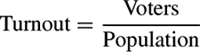
where
Voters = number of voters casting ballots for all candidates
Population = number of individuals eligible to vote in the election
It would seem straightforward to compute both of these counts. It is not - especially in attempting to estimate turnout historically. Furthermore, these two counts may not fully help us to understand why voter turnout rises or declines.
Most explanations of turnout in the United States focus on impediments to voting. Access to the voting booth is provided only to those members of the eligible electorate who choose to register their interest in voting. In this manner, turnout may be conceived as the product of two ratios:

where
Registered = the number of individuals registered to vote
Conceptualizing turnout as the product of two ratios helps us to understand some of the reasons why voters may not turn out. Of course, recent experience suggests that institutional barriers are not the only obstacles preventing Americans from voting. New national registration laws (for example, the "Motor Voter Law”), the easing of date and time restrictions, alternative registration methods, and campaigns to register voters in many states have failed to stimulate significant increases in turnout in the last several elections. Many new registrants, disinterested in politics, would have been nonregistrants without the easing of registration rules. These individuals, while now registered, have a hard time making it to the polling place on election day. 9
In any case, attempts to measure voter participation encounter significant problems with both the numerator of the first ratio and denominator of the second. 10 The bottom line in estimating turnout is that we do not have accurate historical counts of either voters or populations.

Lacking a count of the number of voters, turnout is typically calculated on the basis of the number of votes recorded for the highest office in the jurisdiction counting ballots. The presumption is that the number of votes cast for the most important office reasonably reflects the total number of voters participating. In presidential election years, the total number of votes is typically the number of votes cast for all presidential candidates. What we miss by taking this approach is several different sets of voters whose intents may differ widely.
- Voters who participate but do not vote for all offices (especially the one at the top of the ticket).
- Disqualified voters: those who appear at the polling place and are not allowed to vote for legal reasons or are prevented from voting by legal or illegal means.
- Disqualified ballots: ballots mis-marked by the voter or mis-scored by the counter.
- Abstainers: those who intend to make a political statement by their nonparticipation.11
Because none of these voters are systematically recorded by state election officials, the vote count that serves as the numerator in any calculation of turnout is an undercount of the actual number of voters. What we do not know is by what extent this numerator misrepresents the total number of individuals who express their preferences in any given election. Recent research suggests the national undercount is on the general order of 2 to 3 percent, but the percentage may range far more widely in local electorates (McDonald and Popkin 2001; McDonald 2002).
Yet even if we had an accurate assessment of all of the components of the "undercount,” we would have to recognize that the numerator - number of votes cast - is still imperfect. Counts are subject to a variety of recording errors, some intentional and others not. Incomplete counts may be recorded and not corrected. Records may be lost. Voting machines may not work properly. False results may be reported as true vote counts. 12 All of these problems have occurred in American electoral history.

At first blush, this component of turnout is less subject to manipulation. Yet the measure of population used in estimating voter turnout is flawed or misunderstood.
The first issue is conceptual. Whom do we want to consider as the base population for estimating turnout? Should turnout be calculated as a proportion of those eligible to vote during the period for which turnout is calculated? Or, when making historical comparisons of turnout, should the base be some standard against which all eras can be judged equally? For example, turnout in the 1850s could be calculated as votes cast divided by (1) an 1850 definition of the eligible population, (2) a 2000 definition of the eligible population, or even (3) a "gold standard,” a hypothetical definition of a fully eligible society. Normally, turnout is estimated as current vote count divided by current voting age population, and these estimates are often the basis for concerns about the contemporary turnout rates. But if turnout were calculated as current vote divided by modern definitions of voter eligibility or some ideal eligible population, a much more optimistic view of contemporary turnout would likely emerge. Operationally, "accurate” population estimates are produced only once per decade. To call the Census Bureau's decennial census of the U.S. population accurate likely strains credibility, but by treating it as a preliminary approximation, a reasonable estimate of the vote-eligible population may be produced. In modern times, the Census Bureau and local agencies do provide intercensus estimates of some jurisdictions. Typically, intercensus population estimates may rely on the most immediate census, the prior census, or some extrapolation across two or more time periods.
In estimating turnout, it is important to recognize that the population eligible to vote is not the same as the population count produced by the Census Bureau. The first section of this essay outlined the slow legal expansion of franchise. Yet the history of voting is replete with local obstacles that constitutional changes by themselves could not overcome. The passage of laws without enforcement and the enactment of local laws to contradict federal edicts play a large role in establishing who could and could not vote. Only continuing efforts by the federal government served to change practices.
Although modern America operates on the premise that universal suffrage exists, not all residents or even all citizens of the United States have the right to vote. Most of those without the right to vote have little political voice and consequently little chance of having this right extended to them. Commonly overlooked is the startlingly large number of American citizens who have been disenfranchised by their criminal activity. 13 Institutionalized persons may not be eligible, or may not be able to vote if eligible. Other residents are not enfranchised because of their lack of citizenship. Both legal and illegal immigrants reside in the United States without access to the basic opportunity to decide who will make the laws governing their lives (Harper-Ho 2000). In addition, a popular movement today lobbies for the "rights of the disabled.” Such voters are not legally barred from voting, yet simple obstacles often block their access to the voting booth (Schriner, Ochs, and Shields 1997). Finally, residents of the District of Columbia have no representation in Congress. 14 Additional counting errors arise in mis-identifying the residential location of military personnel. All of these sources of population may or may not be included in the population figures used to estimate turnout. Errors committed in estimating voter populations impact assessments of voter turnout. Consequently, a recent set of papers argues that the denominator typically used in estimating voter turnout - voting age population (VAP) - is simply not adequate. McDonald and Popkin insist that the appropriate theoretical denominator is voting eligible population (VEP) (McDonald and Popkin 2001; McDonald 2002). After adjustment of official population figures for ineligible citizens located in the states who are counted and eligible citizens residing abroad who are not counted, the dramatic falloff in presidential turnout observed during the past thirty years disappears. The decline is due to the sharp increase in recent years in the number of persons of voting age population who are not eligible. McDonald notes that an "astonishing” 19.8 percent of the California VAP are noncitizens (McDonald 2002). But the number of noncitizens varies widely by state, with eighteen states having noncitizen populations that total less than 2 percent of the VAP.

Voter turnout estimates for American presidential elections based on Walter Dean Burnham's work are presented in Table Eb62–113. Table Eb114–122 reports competing estimates of presidential turnout offered by Jerrold Rusk, who makes a special effort to incorporate the history of voter eligibility exclusions and inclusions to more closely approximate VAP (Rusk 2001). All turnout estimates have their imperfections. They are based on imperfect counts and approximating assumptions. Different historical estimates of both the numerator (the number of voters) and the denominator (population) affect the results. 15 But most track quite closely, and none give a decidedly different image of the approximate turnout and turnout trends of American voters. 16 Again, the exception here is the work of McDonald and Popkin, which offers a more optimistic assessment of voter turnout, one that quite reasonably reflects a reassessment of the population component of turnout estimates (McDonald and Popkin 2001; McDonald 2002). Presidential turnout rates rise and decline throughout American history. More than 80 percent of enfranchised Americans participated during the latter half of the nineteenth century. Only about 50 percent turned out to vote in the 2000 election. Most contemporary commentary focuses on this recent "failure” of the American electorate to exercise their franchise by participating in presidential elections. Yet modern turnout rates, although low, are not uncommon historically. The next section offers some specific insights into why rates are high or low during particular periods, but a broad-brush understanding of turnout motivated by political interest is appropriate here. Anthony Downs offers an analytic explanation captured more fully by Benjamin Page. Downs insists that turnout is a rational act: if there are benefits to be gained from voting, individuals will vote. If not, voters will not turn out (Downs 1957). Page picks up this theme in investigating American presidential elections (Page 1978). When the presidential race consists of a contest between Tweedledum and Tweedledee, voters have no incentive to vote. The outcome, regardless of who is elected, will be the same. In contrast, when the candidates offer widely different programs to the voters such that who is elected does matter, voters have a reason to pay attention to the campaign and participate on election day. Throughout history, political parties have offered different options. "Choices” offered to the public matter. When one candidate's campaign "echoes” another's, elections do not matter and voters do not turn out.
Turnout for nonpresidential elections falls well below presidential election turnout, particularly in the modern era. Table Eb260–263 extends the congressional vote count series reported in the previous edition of Historical Statistics of the United States (1975). Table Eb114–122 reports Rusk's estimates of turnout for congressional races. Rusk's narrower conception of VAP produces a slightly higher turnout rate each year, but the trends are the same. 17 Relatively few Americans participate in midterm elections today, with turnout rates hovering around 40 percent. Yet the historical record shows a different picture in early times. From the 1830s through the First World War, more than half of all eligible voters turned out for midterm elections. It was not uncommon for two thirds of the electorate to participate in these races.
Series Eb208 and series Eb260 allow comparison of total votes cast in presidential and "midterm” congressional election years. 18 Voters consistently cast fewer votes for House candidates than they do for the presidential contestants. Commenting on the "saw blade” pattern of voter turnout from one presidential election to the next with interspersed midterm elections, Campbell invoked the theory of "surge and decline” of electorates to explain the participation pattern so regularly observed among Americans (Campbell 1966; also see Kramer 1971; Kernell 1977; Campbell 1987; Erikson 1990; Jacobson 1990; Coleman 1997). This theory is consistent with the Downs and Page perspectives on presidential voting: as voter interest peaks during presidential elections, so too does voter turnout. With less excitement to pull marginal voters to the polls, core and typically partisan constituencies dominate participation in midterm elections.
Ultimately, commentary on American voter turnout turns on a "glass half-empty or glass half-full” assessment of contemporary participation. Voter turnout in modern American presidential elections hovers around 50 percent of the electorate, and turnout in most other races at most other times is a fraction of presidential election turnout. Yet in contrast to the few citizens who were both eligible to vote and willing to do so 200 years ago, more than 100 million Americans voted for George W. Bush, Albert Gore, Ralph Nader, or the several minor party candidates in the 2000 election.
Figure Eb-B dramatically illustrates these two patterns and the conundrum for analysts. It is easy to be critical of the decline in voter turnout. Yet the history of the expansion of the franchise, although difficult at times, has broadened the definition of the electorate far beyond the comprehension of the Founding Fathers.
The two-sided assessment of turnout continues in comparisons made to other democratic countries. U.S. turnout appears to be quite low. Indeed, if the United States operated under election rules existing in other nations, it would fall perilously close to having elections without results. For example, Serbia's 2002 presidential election was declared null and void because turnout fell below 50 percent. Yet if we consider turnout by just those voters who are registered to vote, U.S. turnout is substantially higher. Overall turnout by registered Americans in recent elections hovered between 65 and 70 percent, with turnout in some states approaching levels equivalent to European participation rates. Yet even a more positive view of voter participation rates based on registered voters leaves the United States near the bottom in comparison to established democracies in Western Europe. Interestingly, however, voter turnout declined throughout the world during the 1990s ( International Institute for Democracy and Electoral Assistance 2003).

The turnout roller coaster that is Figure Eb-B represents not only the impact of legal changes to the franchise but also the inner workings of national, state, and local politics combined with the wide assortment of exogenous shocks to the American political system. The surge in national voter turnout observed in the 1828 election of Andrew Jackson clearly represents the impact of a shift in state election laws to adult white male suffrage. The subsequent development of mass-based parties during the 1830s produced a sea change in electoral competition from the narrow elite-based era that preceded it. This new party system supported and encouraged the participation of American white males. Slavery, and the economic, social, and moral issues that accompanied it, polarized the nation and spurred further partisan competition. Dramatic demographic changes - a consequence of westward expansion, economic opportunity, and immigration - also altered the nature of political competition. Periods of economic hardship and competition between groups spurred political struggles and inspired public participation. Internal, regional, and finally world war inspired lively debate and fueled interest in politics. Changes in the late nineteenth and early twentieth centuries, however, seemed to stifle public involvement. The period from 1890 to 1920 represents an era of massive immigration (rivaled only by the influx of new immigrants during the last twenty years of the twentieth century) in which new citizens - not socialized to participation in politics - joined the ranks of the American electorate. Turnout fell from 80 percent down to 50 percent in thirty years. Voter turnout during the 1920s rivals modern voting patterns. Low turnout and declining partisan allegiances seen during this era set the stage for the politically tumultuous 1930s and the rewriting of the American party system. The onset of the Great Depression shifted the balance of political power from Republicans to Franklin Roosevelt and Congressional Democrats and sparked a revival of relevance of the parties as their differences came to be seen more starkly. Over the last forty years, however, public involvement in national elections gradually declined as campaigns became "candidate-centered” (Wattenberg 1987, 1991) and parties withered as objects of voter attachment to the political system. Whether the limited turnout rates observed in the late twentieth century presages new changes in political competition remains for future assessment.
Hidden in the big picture are a variety of subplots. The emancipation of blacks and their enfranchisement was very quickly followed by new restrictions. "Jim Crow” laws were written to discriminate against blacks. Given full support by the Supreme Court's infamous Plessy v. Ferguson decision (Plessy v. Ferguson, 163 US 537 (1896)), white supremacy movements throughout the South prevented many blacks from fully participating in the political system until the 1960s.
Explanations for the rise and decline of voter participation throughout American history range far beyond simply identifying the legal and extralegal expansions and contractions of the franchise. They also unfortunately range far beyond the scope of this essay. Even an answer to the restricted question "Did changes to the franchise increase aggregate participation while lowering participation rates?” is not easy to come by. Many believe the expanding right to vote has had precisely the effect of lowering turnout rates while increasing turnout. Academic debate over the decline in voter turnout during the early years of the twentieth century broadly pits social conditions against legal and institutional restrictions as the key explanation for the downturn in voter participation. 19 Likely both perspectives are right - and wrong. The explanations are complex, and single-variable answers are not viable. Explanations of turnout rates based solely on legal shifts in the right to vote have been criticized as inadequate or incomplete. For example, was enfranchisement of women the reason why turnout declined precipitously in the 1920s? Kleppner argued, to the contrary, that political context, most reasonably operationalized as electoral competition, is the basis for a significant portion of the 1920 reduction in voter turnout. 20 Turnout by men as well as women declined during this era. Furthermore, the lack of a common pattern of reduced voting across states and across time suggests that female suffrage is not the definitive explanation for the downturn in turnout. Similarly, recent declines in voter turnout are often blamed on the 1972 expansion of the franchise, the granting of voting rights to 18- to 20-year-olds. Historically, the youngest cohorts in the electorate have turned out at significantly lower rates than other age groups. The enactment of the Twenty-sixth Amendment exacerbated this tendency, although the campaign of 1992 appeared to have energized young voters more than any election in the last thirty years. Sole blame for recent declines in turnout cannot be placed at the feet of young voters.
Of recent institutional changes that have had positive effects on voter turnout, none may have been so important as the Voting Rights Act of 1965, which produced major changes in voter registration in the South. From 1960 to 1970, voter registration rose 8.1 percentage points among white voters (from 61.1 to 69.2 percent). But the real impact of this law was to improve opportunities for minority voters. During this decade the proportion of black citizens registered to vote more then doubled, rising from 29.1 percent to 62.0 percent. These changes were not uniform. The largest improvements occurred in states with very low black registration rates at the start of the decade. South Carolina and Alabama registration figures for blacks rose 309 percent and 382 percent, respectively. In Mississippi the percentage of black citizens registered to vote rose from 5.2 percent to 71 percent, an astounding 1,265 percent increase in registered voters over the decade. By the end of the decade, most of the South continued to show higher white registration rates, although the differences between races shrank markedly. The lone exception was Texas, in which the proportion of black voters exceeded the registration rates of white voters by 1970.
Yet progress toward racial neutrality in voter registration of the 1960s was short lived. During the next decade, minority registration rates fell, while white registration rates increased, tripling the gap between white and black voter registration by 1980. White registration increases may be attributable to "blacklash” against newly enfranchised blacks. Mississippi, for one, engaged in patently illegal registrations. According to the statistics of the Southern Regional Council's Voter Education Project, more than 100 percent of white Mississippians were registered to vote in 1980 (Statistical Abstract, 1981, p. 495).
While institutional explanations do not always satisfy, it is not the case that social and demographic change is the alternative explanation for turnout decline. For example, despite the apparent correlation between immigration and voter turnout, Tuckel and Maisel find little evidence directly tying immigration to the reduced participation by electorates at the turn of the century (Tuckel and Maisel 1994). Although county-level data point to low turnout in areas populated by immigrants, these data capture primarily patterns in rural voting. Examination of ward data in urban areas indicates, in fact, that voting rates were higher in places with large foreign-born populations. The potential to grab control of power in urban areas created justification for voters to participate in the political arena.

Despite the popular perception that the public chooses the President, Article 2, Section 1 of the U.S. Constitution establishes electors for that task in a process referred to by most as the "electoral college.” 21 At present, each state selects, by popular vote, a group of electors equal in number to its total of members of Congress. The District of Columbia also has three presidential electors granted by the Twenty-third Amendment, adopted in 1961. After the general election, those selected as electors meet in their respective states to vote for President and Vice President. The 2000 election again shows the relevance of the electoral college vote. For the fourth time in U.S. history, a candidate who did not win the popular vote was elected President. A state's representation in both the electoral college and the U.S. House of Representatives is governed by its share of the national population, which is affected by population growth and interstate migration. Relative changes in population - together with the principle of "one person, one vote” - produce a reapportionment of the House and the electoral college each decade (for apportionment, see Table Eb1–56, Table Eb57–61; for votes in the electoral college, see Table Eb149–153, Table Eb154–207).

The voting statistics reported in Table Eb62–113, Table Eb114–122, Tables Eb149-267 tell a second critical story about American political history, a story about the ebb and flow of support for the major political parties. With the publication of V. O Key's influential papers on "critical elections” and "secular realignments,” the study of elections turned to focus on theories of realignment (Key 1955, 1959). Realignments - shifts in the balance of partisan power in the electorate and the institutions of government - were observed to occur with predictable regularity: forty-year cycles of one-party dominance broken or confirmed by cataclysmic "critical” elections (Burnham 1965, 1970; Ladd and Hadley 1978; McCormick 1982, 1986). The elections of 1860, 1892, and 1932 changed the face of Washington politics. The observed periodicity of realignments has spawned a variety of hypotheses to explain their strength and duration. By the late 1960s a new realignment was expected. It never happened - at least not in the way realignments had occurred previously. As a result, many political scientists and historians questioned the value of realignment theories (Lichtman 1982; Carmines and Stimson 1989; Shafer 1991; Aldrich and Niemi 1996; Aldrich 1999; Shea 1999). The failure of cyclical theories to predict the next period of party dominance has yielded to alternative visions of the future, with political scientists offering a menu of dealignment, the end of realignment, punctuated equilibria, a sixth-party system, and a "baseless” party system among the options. Historians have taken the failures of realignment theory in a different direction. Silbey, drawing on his earlier collaborations with Benson and Field, finds "political eras” a more satisfying construct capable of extending analysis to normal periods of American politics. In a similar vein, Shafer offers the notion of "electoral order” as a concept capable of bringing coherence to the discussion of American political history (Silbey 1991; Shafer 1991).
In place of realignment, the focus in political science has shifted to the study of "divided” government, the control of the executive by one party sharing power with the other major party in command of one or both of the chambers of the legislature. Attention is directed primarily at the partisan control of the institutions of government, although those seeking explanation for patterns of divided government still look to elections and the behavior of voters to explain the reasons why governments cannot be unified under the direction of a single political party.
Some may see this shift to divided government as simply a shift in the historical focus point. Rather than study the periods immediately after critical elections when government is unified behind a dominant party, scholars now look to the end of periods of party dominance and focus on those times when competition becomes more heated and control by a single party is not a given. Yet the picture political history offers up is not so obvious, especially as our attention moves from the national level to state political competition. The first half of the twentieth century, a period of unified government, tends to dominate expectations of "normalcy.” Yet this period is unique in American history. Fiorina notes the common occurrences of divided government throughout the nineteenth century, in contrast to the unified governments of the first half of the twentieth century (Fiorina 1996). The last thirty years are more typical than we often believe (see Table Eb296–308 for the partisan divisions within the national government). Whether we study American political history from the perspective of realignment and critical elections, from the perspective of political periods, or with divided government the common pattern for periods of normal politics, we are looking at the same data with different lenses. The Gestalt principle of figure and ground (most often recognized in visual form as optical illusion - a picture of two faces or a vase) serves as a reasonable analogy for our perception of American political history as one "most usefully” examined as critical elections, stable party periods, or shared control of national government. Each perspective offers a different insight into the operation of the American democracy.

A realignment perspective on American political history is not based solely on the behavior of the voting public. The operation of government over broad periods of American history can be traced by examining major changes in national and local institutions, changes most typically represented by the extensive and dramatic shift in power within our governing institutions from one major political party to another. Certainly authors describing realignments recognize this institutional component (Burnham 1965; Lowi 1967; Huntington 1981; Sundquist 1983; Lichtman 1976; Clubb, Flanigan, and Zingale 1980; Brady 1988; Morone 1990; Jillson 1994).
Examination of the control of the institutions of the national government focuses attention on the partisan divisions within the U.S. Congress, as well as the party affiliation of the sitting President (see Table Eb296–308). 22 Although the President often has a different perspective on public policy than his colleagues in the Congress, it is quite clear that party is the glue that holds the federal system together. It is simply far easier to find common ground in enacting laws when both institutions are populated by members of the same political party with similar ideological preferences. 23
Partisan control presumably has some impact on the nature of government policy. Both chambers of the U.S. Congress are organized by their respective majorities. Seat margin in the House of Representatives and Senate influences the composition of committees as well as the flexibility with which leadership can attend both to programmatic direction and to constituency needs of its members. The importance of party unity for the passage of legislative agendas increases when majority status grows more tenuous.

Do realignments presage policy shifts (Brady 1988)? Is unified government critical for advancing legislative agendas (Sundquist 1988–1989)? Does divided government promote deadlock (Burns 1963, 1966)? The evidence is surprisingly mixed, and the debate is likely to continue (Mayhew 1991; Jones 1994).
Simple questions about congressional activity in the face of interchamber party division or division between the party controlling the Congress and the party of the President may be answered by comparing Table Eb268–278 and Table Eb296–308. Table Eb268–278 provides information on the number of bills and resolutions considered and enacted in each Congress. Care must be exercised in comparing counts of bill and resolution introductions and enactments across historical periods. Significant differences exist in the length and breadth of the subject matter covered at different points in time. A single omnibus bill may substitute for many individual topic bills. The abrupt reduction in the number of private bills enacted into law beginning with the 60th Congress was the result of combining many private bills, particularly pension bills, into omnibus enactments.
The number of bills enacted is also affected by the nature and timing of congressional reforms (Adler 2002). In 1855 Congress established the U.S. Court of Claims to examine and resolve contractual claims made against the United States government. In 1946, in response to the dramatic rise in private legislation following the First World War, Congress banned several types of private legislation in the Legislative Reform Act. 24 Prior to then, private legislation had occupied considerable congressional time, precluding consideration of public legislation. Its virtual elimination dramatically shifted the balance of activity back to a focus on public bills and resolutions.

Conflict between Congress and the President is most visible in the veto process represented in Table Eb279–284. The number of bills vetoed is often a function of the partisan division across these institutions (Copeland 1983; Shields and Huang 1995). Periods of divided government typically presage more vetoes than eras in which a single political party claims both Congress and the presidency. Yet intraparty disagreements also promote conflict over legislation even when Congress and the President are of the same partisan affiliation. In modern times, presidential vetoes have come most often when a Republican President has faced off against a Democratic Congress. Presidents Eisenhower, Nixon, Ford, and Reagan confronted Congress over a number of important bills (Watson 1993; Cameron 2000). Only Eisenhower carried the day without significant losses. While Congress was able to override Eisenhower's veto only twice, the other modern Republican Presidents lost approximately 25 percent of their constitutional disagreements with Congress over legislation.
The subsequent success or failure of Congress to override the presidential veto is a function not only of partisan differences between President and Congress but also of the magnitude of partisan divisions within each chamber (Rohde and Simon 1985). Presidents who face an extraordinary majority of the opposing party face long odds in vetoing legislation. But such majorities are rare. The loyalty of members of the President's party makes building the two-thirds vote necessary to override a veto quite difficult under most circumstances.

Summary measures of the President's success in passing his program are reported in Table Eb285–295. Scores are constructed by Congressional Quarterly Press based on roll call votes on bills for which the President has taken a stand in favor or in opposition. A number of caveats must be acknowledged when using such scores to infer how good a job the President is doing, how well the President and Congress work together, or which chamber works best with the President. Problems affecting inferences of presidential success include:
- Bills killed in committee are not counted.
- Bills passed or defeated on voice vote are not counted.
- All votes are equally weighted, regardless of importance.
- Bills are weighted by the number of votes taken.
- The two chambers of Congress may disagree on a bill (which may not be the same bill).
- Amendments will differ across chambers.
Owing to such considerations, the operational "presidential success” score has been roundly criticized, but few simple alternatives exist (Edwards 1985; Pritchard 1986; Collier and Sullivan 1995).
Nonetheless, many scholars substitute alternative measures in their attempts to examine the interactions between President and Congress. Peterson, Mayhew, Jones, Howell, and others have identified different classes of legislation as more or less important and hence worth more or less in interpreting how successful the branches of government are in working together or legislating "alone” (Peterson 1989; Mayhew 1991; Jones 1994; Howell, Adler, et al. 2000). Typically this work evaluates legislation subjectively and ordinally, ranking bills on a simple scale from "landmark” to "mundane.”
Contemporary research on presidential success focuses on the conditions underlying success or failure - for example, control of the Congress by the President's party, or the magnitude of a Congressional majority. Consequently, the discussion of presidential success highlights the link between divided government ( Table Eb296–308) and the passage of the presidential program ( Table Eb285–295). The conclusion of this literature is that no single conclusion exists (Chamberlain 1946; Moe and Teel 1970; Edwards 1989; Peterson 1989; Mayhew 1991; Jones 1994). At different points in time, the Congress is shown to be more or less supportive and the President more or less successful. More constructively, Peterson and Jones recognize that no institution can enact law on its own: lawmaking proceeds best when the President and Congress "work together” (Peterson 1989; Jones 1994). Indeed, a focus on institutional success may misread the reality of American government. Such a perspective is simply myopic. Furthermore, the inability of any single institution to be successful on its own does not preclude all politicians from claiming credit for political successes. And with the apparent exception of Harry Truman - who famously declared "the buck stops here” - all elected officials seek to avoid blame for policy failures.

The advent of public opinion polling - first as commercial enterprise and later as academic and scientific exercise - has transformed our ability to understand the nature of the aggregate political statistics that have been collected since the founding of the Republic. Beginning with the regular efforts of Gallup, Harris, Crossley, and Roper in the 1930s, Americans have faced a steady barrage of pollsters wondering about their assessments of the state of the nation, the performance of the President, and myriad problems that have faced the nation, from the condition of the economy to the world at war (Converse 1987). Following World War II, academic survey researchers, many of them recruited from the federal bureaucracy, joined commercial pollsters in the streets and later on telephones to query Americans about their opinions on political and social issues of the day.
Early public opinion research concentrated on current events. More recently, academic researchers and commercial survey firms have recognized the value of time series survey data for assessing contemporary opinions (Page and Shapiro 1992; Mayer 1993). Only with the perspective offered by prior opinions can the current mood of the country be evaluated. The answer to the question "Is the glass half full or half empty?” is partially answered by knowing whether it used to be full or empty.
This short discussion cannot do full justice to the many facets of public opinion that have been the focus of study by survey researchers. Rather, it offers a brief history of the basic partisan attachments of the public, a summary of popular stands on issues in broad ideological terms, and a description of public judgments of presidential performance in office over the past fifty years.

The occasional subject of speculation prior to the Second World War, the partisan and ideological leanings of Americans moved to center stage in the postwar era. Both political and academic interest in the hearts and minds of Americans stimulated this data collection. McCarthy-era investigations into the political preferences of Americans - particularly the radical, fascist, and communist tendencies of some - reinforced perceptions that underlying political predispositions play an important role in the decisions Americans made in going to the polls on election day.
Although questions about the political predispositions of the public have been asked in public opinion polls for almost seventy years, attention to the critical nature of party identification is largely the result of the emphasis placed on it by researchers at the University of Michigan. The defining moment for this tradition was the 1960 publication of The American Voter by Campbell, Converse, et al., who insisted on the centrality of party attachment in the decisions of Americans facing the ballot box (also see Campbell, Gurin, and Miller 1954; Campbell, Converse, et al. 1966; and Miller and Shanks 1996). The standard survey approach to measuring party identification is the question "Generally speaking, do you usually think of yourself a Republican, a Democrat, an Independent, or what?” Academic researchers with the flexibility of asking more questions than commercial surveyors typically add one of two follow-ups. For those who respond to the initial question that they believe themselves to be a member of one major party or the other, the second question is "Do you believe yourself to be a strong [Democrat/Republican] or a weak [Democrat/Republican]?” For those who declare their independence from the two dominant parties in response to the first question, the next question is, "Do you lean toward the Democratic Party or the Republican Party?” The combination of these three questions produces a seven-point index ranking party identification from strong Democrat at one extreme to strong Republican at the other (see Table Eb309–316). These three questions can also serve to rank respondents on the strength of their partisan identification: a "pure” independent, an independent leaning toward a party, a weakly identified party member, or a strong supporter of a party. The post-World War II era began with a plurality of Americans identifying with the Democratic Party. Representing the continuance of the New Deal coalition, almost twice as many Americans identified with the Democratic Party as with the Republican Party throughout the 1950s and 1960s. The high point of Democratic Party support among the general public occurred during the Johnson landslide of 1964, when 52 percent of Americans claimed to identify with the party of the President. It should be emphasized that party identification does not by itself determine election outcomes. For example, despite these general predispositions of the electorate, the immense popularity of Dwight David Eisenhower led to Republican control of the White House for almost half of these two decades. Election outcomes hinge on turnout rates among party groups, as well as success in attracting independents and members of the opposition while retaining party identifiers.
The late 1960s and early 1970s represent a watershed period in modern American politics. Public dissatisfaction with government, reflected in concerns about civil rights, the environment, the war in Vietnam, and election tactics produced significant shifts in the attachments of the public to the major parties. Within the span of eight years, both parties lost supporters and the number of "Independent” Americans grew dramatically. By 1974, Democrat and Independent were the responses of about 40 percent of the public, while barely one fifth of those polled identified with the Republican Party, an apparently unattractive alternative in the wake of the resignation of President Nixon in August 1974.
The Republican Party won back some of their support and gained adherents among new voters during the next twenty years. However, 1994 proved to be the high point of Republican support. Despite recent success in both chambers of Congress, the party has not won more converts. The 2000 electorate is composed of a plurality of Independents. Democrats remain the larger party, with Republican support falling to barely one fourth of the public.
Elections have changed over time, and parties seem to play a lesser role in the decisions of voters today. Candidates themselves emphasize this change. Recognizing the strategic need to capture the independent voter, rarely do candidates advertise their party affiliation. Campaigns promote voting for the candidate. Consequently, "the person, not the party” is the rationale underlying many voter decisions in this candidate-centered era (Wattenberg 1998). Nonetheless, in less visible races, lack of information means that party remains a key clue for voters.

The ideological identification of the American public has been investigated by pollsters in a variety of ways. Modern questions vary from the Gallup and media versions (for example, "How would you describe your views on most political matters? Generally, do you think of yourself as liberal, moderate, or conservative?”) to academic versions that solicit greater variation.
Contemporary America is populated by citizens who describe themselves as "conservative” far more often than they call themselves "liberal.” Yet more popular than either choice is the American preference for "moderate” or "middle of the road.” The self-identified ideological preferences of Americans shift very slowly, with only minor aggregate change over time. 25
Yet citizen ideological self-identification does not always point definitively to the public's preferences for individual policies. The mass public is rarely as constrained as political elites in the clustering and consistency of their attitudes about political actors, institutions, and policies (Converse 1964; Erikson, Mackuen, and Stimson 2002; Stimson 1999).
Recently, Stimson has provided a classification of the ideological "mood” of the American public based on their issue positions (see series Eb317) (Stimson 1999). This series is much more volatile than ideological self-identification and clearly shows the ebb and flow of public anticipation of and reaction to public policy. Stimson argues that American public opinion defines a zone of acceptable behavior for its political leaders, with public preferences regulating the extremes to which government officials may go. As policies near the extremes, public pressures pull them back toward the mainstream. Thus, we see in these policy mood data a tendency for public opinion to swing against what is often seen as the prevailing political tendency. As an example, the public mood swung in a decidedly liberal direction throughout the Reagan presidency.

For better or worse, the "buck” often stops at the White House. Americans typically judge their government by their President. This perspective - which might be thought of as government personalized - is commonly found among children (Greenstein 1965; Easton and Dennis 1969), and even though adults have much more complex images of the government, their impressions are often formed in response to presidential action or inaction in national and world events.
Since the mid-1930s, public opinion polls have regularly asked Americans what they thought about the performance of the incumbent President (Edwards and Gallup 1990). Although individual assessments of a sitting President can be quite detailed, the query used by the Gallup organization throughout this period is straightforward: Do you approve or disapprove of the way President [name of incumbent] has handled his job as President? Despite the limitations of this question (and two follow-up questions often asked of his specific handling of the economy and of foreign affairs), it remains a key indicator of general levels of public support for the President and an indicator of presidential "power” (Neustadt 1960; Brace and Hinckley 1992).
Annual averages of public responses to the Gallup presidential job approval question for the period 1948–2000 are reported in Table Eb318–328. The degree of variation around these annual averages is reflected in the highest and lowest support reported for any individual poll for each year. Although the individual polls are not reported in the series, Figure Eb-C does show the intra-annual variation in public support for the President and highlights the degree of variation surrounding the annual averages. Common patterns in this series have been observed by many scholars. With few exceptions, to be popular as President is to be popular early in the administration. The political "honeymoon” of newly elected leaders is quite visibly captured in the graph of public support for each administration from Truman to Clinton. This initial approval is usually followed by a decline in popularity. George Herbert Walker Bush is the clear exception. Unlike the common pattern with other Presidents, Bush's approval rating steadily increased during his first three years in office. His fourth-year crash in the polls, from the highest job approval rating ever recorded, was closely followed by only the second electoral defeat of an incumbent President in the last seventy years.
In addition to the commonly noted deterioration of support as the President's electoral coalition gradually unwinds, a "rally round the flag” effect has often been observed at times of international crisis (Mueller 1970; Hurwitz and Peffley 1987). Upturns in presidential approval occur during wars and external threats to American national security. That this public response is widely recognized often breeds cynicism about presidential decisions to participate in foreign affairs.
As Neustadt observed, the power of the President is the "power to persuade” (Neustadt 1960). This power to persuade Congress is often a function of the standing the President has with the general public. In both the examination of presidential support and in the passage of particular legislation, public opinion has often been considered a key explanatory variable. 26

Clearly, the value of survey data will increase as the collection of these data expands over time. A number of common difficulties arise in the use of public opinion time series data. Often unconsidered, but perhaps the most common difficulty, is the lack of easily accessible data archives for polling data. Some of these data are lost, while others are merely lost from easy public access. Other common problems arising in the analysis of public opinion data collected over long periods of time include the following: lack of consistent wording; alteration of word meaning; changing sampling techniques; changing interviewing techniques; and "house” (survey organization) effects (Converse and Schuman 1984; Smith 1987).
Each of these problems arises in the analysis of any of the extended time series of public opinion. Indeed, the reader will notice that many of the series reported here could have begun with the first Gallup surveys of 1935 and 1936. They do not, in large part, because these early surveys suffer from enough weaknesses that they were set aside as potentially not comparable with more contemporary data. Early polls, especially those conducted prior to the 1948 campaign, often chose samples with less scientific rigor than we insist on today. Early surveys did not strive for simple demographic balance. Some Southern samples, for example, exclude black respondents. Other surveys did not use probability sampling strategies that allow reasonable inferences to be drawn from the collected survey responses.
But despite their limitations, these time series of public preferences provide critical insights that are simply not observed in the historical time series of elections and institutional control that dominate discussions of political periods in American history. These series help to define the context within which political parties compete for votes. Similarly, they define for the party in office, as well as for their future challengers, the nature of the public agenda to which successful politicians must speak. This is not to insist that public preferences are exogenous in all instances. Politicians by their words and by their actions can affect both the centrality and evaluation of government for the public agenda. But politicians evade the majority of the public at their own peril over the long haul.

The statistical series reported in this chapter represent the story of American politics over the past 200 years. Elections serve as mechanisms linking voter preferences with government officials whose decisions produce public policies. Party groups act as key aggregators of those preferences and the principal means by which governments are organized and policies enacted. For this reason alone, many of the series are about the behavior or preferences of partisans, either in the general public or the political elite.
Multiple stories may be told with these data. Some observers take the position that politicians in government lead the public into accepting the outcomes of the political process. This process may be viewed as benign (with citizens educated by their political leaders) or malevolent (where leadership manipulates citizens). In either case, elections may be seen to follow the decisions of political elites. Others will find a more optimistic image within the details of these historical trends: elections select leaders who deliver democratically chosen policy outcomes. From this perspective, politicians, feeling the call of the reelection imperative, respond to the preferences of their constituents. Within the diverse community that is America, majority preferences are enacted without fear of majority tyranny, as once expressed by the authors of the Federalist Papers. A third set of scholars may find that these data only produce further evidence of the "paradox of modern democracy”: despite a mostly uninformed public, the United States has survived as a relatively stable democracy for more than 200 years (Delli Carpini and Keeter 1996).
These data will not definitively answer the question, "Which portrayal is correct?” But there is enough here to stimulate both sides of the debate. The degree to which the American experiment has successfully produced a democratic polity remains an open and important question.
At the same time, American political history is not well represented as a straight-line extrapolation of trends. Unique events have played (and will continue to play) enormously important roles in defining opportunities for parties and political leaders, while influencing the public's view of their generation's problems and successes. Some of these events are set out in Table Eb-D. The assassination of Presidents, the clash of armies, the crash of markets and economies, and the attack of terrorists seem destined to define eras in American politics. Extraordinary events complicate our explanations of historical paths. They do not, however, make drawing inferences about political history impossible. These data provide the basis for expectations and baselines for understanding deviations from the past.
Figure Eb-B. Voter participation in presidential elections: 1824–2000
Sources
Figure Eb-C. Presidential approval: 1952–2000
Sources
George C. Edwards III and Alec M. Gallup, Presidential Approval: A Sourcebook (Johns Hopkins University Press, 1990); Lyn Ragsdale, Vital Statistics on the Presidency: Washington to Clinton (Congressional Quarterly Press, 1996); The Gallup Poll Monthly (October 2000): 10–12.

Adler, E. Scott. 2002. Why Congressional Reforms Fail. University of Chicago Press.
Aldrich, John H. 1999. "Political Parties in a Critical Era.” American Politics Quarterly 27: 9–32.
Aldrich, John H., and Richard G. Niemi. 1996. "The Sixth American Party System: Electoral Change, 1952–1992.” In S. Craig, editor. Broken Contract: Changing Relationships between Americans and Their Government. Westview Press.
Bollen, Kenneth. 1980. "Issues in the Comparative Measurement of Political Democracy.” American Sociological Review 45: 370–90.
Bollen, Kenneth. 1993. "Liberal Democracy: Validity and Method Factors in Cross-National Measures.” American Journal of Political Science 37: 1207–30.
Bollen, Kenneth, and Burke D. Grandjean. 1981. "The Dimension(s) of Democracy: Further Issues in the Measurement and Effects of Political Democracy.” American Sociological Review 46: 651–9.
Bond, Jon R., and Richard Fleisher. 1990. The President in the Legislative Arena. University of Chicago Press.
Brace, Paul, and Barbara Hinckley. 1992. Follow the Leader: Opinion Polls and the Modern Presidents. HarperCollins.
Brady, David W. 1988. Critical Elections and Congressional Policy Making. Stanford University Press.
Burnham, Walter Dean. 1955. Presidential Ballots, 1836 to 1892. Johns Hopkins University Press and Oxford University Press.
Burnham, Walter Dean. 1965. "The Changing Shape of the American Political University.” American Political Science Review 59: 1–40.
Burnham, Walter Dean. 1970. Critical Elections and the Mainsprings of American Politics. Norton.
Burnham, Walter Dean. 1970/1979. "State-Level Congressional, Gubernatorial and Senatorial Election Data for the United States, 1824–1972.” Inter-university Consortium for Political and Social Research (computer file).
Burnham, Walter Dean. 1974. "Theory and Voting Research: Some Reflections on Converse's ‘Change in the American Electorate.” American Political Science Review 68: 1002–23.
Burnham, Walter Dean. 1975. "Elections and Politics: Series Y1-271.” In Historical Statistics of the United States. U.S. Government Printing Office.
Burnham, Walter Dean. 1980/1987. "Partisan Division of American State Governments, 1834–1985.” Inter-university Consortium for Political and Social Research (computer file).
Burnham, Walter Dean. 1994. "Pattern Recognition and ‘Doing’ Political History: Art, Science or Bootless Enterprise?” In Lawrence C. Dodd and Calvin Jillson, editors. The Dynamics of American Politics: Approaches and Interpretations. Westview Press.
Burns, James McGregor. 1963. The Deadlock of Democracy: Four-Party Politics in America. Prentice Hall.
Burns, James McGregor. 1966. Congress on Trial: The Legislative Process and the Administrative State. Gordian Press.
Cameron, Charles M. 2000. Veto Bargaining: Presidents and the Politics of Negative Power. Cambridge University Press.
Campbell, Angus. 1966. "Surge and Decline: A Study of Electoral Change.” In Angus Campbell, Philip E. Converse, et al., editors. Elections and the Political Order. Wiley.
Campbell, Angus, Philip E. Converse, et al., editors. 1960. The American Voter. Wiley.
Campbell, Angus, Philip E. Converse, et al. 1966. Elections and the Political Order. Wiley.
Campbell, Angus, Gerald Gurin, and Warren E. Miller. 1954. The Voter Decides. Row, Peterson.
Campbell, Bruce A., and Richard J. Trilling, editors. 1979. Realignment in American Politics: Toward a Theory. University of Texas Press.
Campbell, James E. 1987. "The Revised Theory of Surge and Decline.” American Journal of Political Science 31: 965–79.
Canes-Wrone, Brandice, and Scott de Marchi. 2002. "Presidential Approval and Legislative Success.” Journal of Politics 64: 491–509.
Carmines, Edward G., and James A. Stimson. 1989. Issue Evolution: Race and the Transformation of American Politics. Princeton University Press.
Chamberlain, Lawrence H. 1946. The President, Congress, and Legislation. Columbia University Press.
Claggett, William. 1990. "Reported and Validated Voter Registration.” American Politics Quarterly 18: 197–207.
Clubb, Jerome M., William H. Flanigan, and Nancy H. Zingale. 1980. Partisan Realignment: Voters, Parties and Government in American History. Sage.
Coleman, John J. 1997. "The Importance of Being Republican: Forecasting Party Fortunes in House Midterm Elections.” Journal of Politics 59: 497–519.
Collier, Kenneth, and Terry Sullivan. 1995. "New Evidence Undercutting the Linkage of Approval with Presidential Support and Influence.” Journal of Politics 57: 197–209.
Converse, Jean M. 1987. Survey Research in the United States: Roots and Emergence. University of California Press.
Converse, Jean, and Howard Schuman. 1984. "The Manner of Inquiry: An Analysis of Survey Question Form across Organizations and over Time.” In C. F. Turner and E. Martin, editors. Surveying Subjective Phenomena, volume 2. Russell Sage.
Converse, Philip E. 1964. "The Nature of Belief Systems in Mass Publics.” In David Apter, editor. Ideology and Discontent. Free Press.
Converse, Philip E. 1972. "Change in the American Electorate.” In Angus Campbell and Philip E. Converse, editors. The Human Meaning of Social Change. Russell Sage.
Copeland, Gary. 1983. "When Congress and the President Collide: Why Presidents Veto Legislation.” Journal of Politics 45: 696–710.
Dahl, Robert A. 1956. A Preface to Democratic Theory. University of Chicago Press.
Dahl, Robert A. 1989. Democracy and Its Critics. Yale University Press.
Delli Carpini, Michael X., and Scott Keeter. 1996. What Americans Know about Politics and Why It Matters. Yale University Press.
Downs, Anthony. 1957. An Economic Theory of Democracy. Harper and Row.
Dugan, William E., and William A. Taggart. 1995. "The Changing Shape of the American Political Universe Revisited.” Journal of Politics 57: 469–82.
Easton, David, and Jack Dennis. 1969. Children in the Political System. McGraw-Hill.
Edwards, George C., III. 1985. "Measuring Presidential Success in Congress: Alternative Approaches.”Journal of Politics 47: 667–85.
Edwards, George C., III. 1989. At the Margins: Presidential Leadership in Congress. Yale University Press.
Edwards, George C., III, and Alec M. Gallup. 1990. Presidential Approval: A Sourcebook. Johns Hopkins University Press.
Erikson, Robert S. 1990. "Economic Conditions and the Congressional Vote: A Review of Macrolevel Evidence.” American Journal of Political Science 34: 373–99.
Erikson, Robert S., Michael Mackuen, and James A. Stimson. 2002. The Macro Polity. Cambridge University Press.
Fellner, Jamie, and Marc Mauer. 1998. Losing the Vote: The Impact of Felony Disenfranchisement Laws in the United States. Human Rights Watch.
Fiorina, Morris P. 1996. Divided Government, 2nd edition. Allyn and Bacon.
Franklin, Daniel P., and Eric E. Grier. 1996. "Effects of Motor Voter Legislation: Voter Turnout, Registration, and Partisan Trends in the 1992 Presidential Election.” American Politics Quarterly 25: 104–17.
Gastil, Raymond D. 1978. Freedom in the World: Political Rights and Civil Liberties. Freedom House.
Greenstein, Fred I. 1965. Children and Politics. Yale University Press.
Gurr, Ted Robert, Keith Jaggers, and Will H. Moore. 1990. "The Transformation of the Western State: The Growth of Democracy, Autocracy and State Power since 1800.” Studies in Comparative International Development 25: 73–108.
Harper-Ho, Virginia. 2000. "Noncitizen Voting Rights: The History, the Law and Current Prospects for Change.” Law and Inequality 18 (2): 271.
Harvard Law Review. 1989. "The Disenfranchisement of Ex-Felons: Citizenship, Criminality and the Purity of the Ballot Box.” Harvard Law Review 102: 1300–17.
Harvey, Alice E. 1994. "Ex-Felons Disenfranchisement and Its Influence on the Black Vote: The Need for a Second Look.” University of Pennsylvania Law Review 142: 1145–89.
Howell, William, E. Scott Adler, et al. 2000. "Measuring the Institutional Performance of Congress in the Post-war Era: Surges and Slumps in the Production of Legislation, 1945–1994.” Legislative Studies Quarterly 25: 285–312.
Huntington, Samuel P. 1981. American Politics: The Promise of Disharmony. Harvard University Press.
Hurwitz, Jon, and Mark Peffley. 1987. "The Means and Ends of Foreign Policy as Determinants of Presidential Support.” American Journal of Political Science 31: 236–58.
International Institute for Democracy and Electoral Assistance (IDEA). 2003. "Voter Turnout from 1945 to Date.” Downloaded from the institute's Internet site.
Jackman, Robert W. 1987. "Political Institutions and Voter Turnout in Industrial Democracies.” American Political Science Review 81: 405–24.
Jacobson, Gary C. 1990. "Does the Economy Matter in Midterm Elections?” American Journal of Political Science 34: 400–4.
Jillson, Calvin. 1994. "Patterns and Periodicity in American National Politics.” In Lawrence C. Dodd and Calvin Jillson, editors. The Dynamics of American Politics: Approaches and Interpretations. Westview Press.
Jones, Charles O. 1994. The Presidency in a Separated System. Brookings Institution Press.
Kernell, Samuel. 1977. "Presidential Popularity and Negative Voting: An Alternative Explanation of the Midterm Congressional Decline of the President's Party.” American Political Science Review 71: 44–66.
Key, V. O., Jr. 1955. "A Theory of Critical Elections.” Journal of Politics 17: 3–18.
Key, V. O., Jr. 1959. "Secular Realignment and the Party System.” Journal of Politics 21: 198–210.
Kleppner, Paul. 1982a. The Dynamics of Electoral Turnout, 1870–1980. Praeger.
Kleppner, Paul. 1982b. "Were Women to Blame? Female Suffrage and Voter Turnout.” Journal of Interdisciplinary History 12: 621–43.
Knack, Stephen. 1995. "Does ‘Motor Voter' Work? Evidence from State-Level Data.” Journal of Politics 57: 796–811.
Knack, Stephen, and James White. 1998. "Did States' Motor Voter Programs Help the Democrats?” American Politics Quarterly 26 (3): 344–65.
Kramer, Gerald H. 1971. "Short-term Fluctuations in U.S. Voting Behavior, 1896–1964.” American Political Science Review 65: 131–43.
Ladd, Everett Carll, Jr., and Charles Hadley. 1978. Transformations of the American Party System, 2nd edition. Norton.
Lichtman, Allan J. 1976. "Critical Election Theory and the Reality of American Presidential Politics, 1916–1940.” American Historical Review 81: 317–50.
Lichtman, Allan J. 1982. "The End of Realignment Theory? Toward a New Research Program for American Political History.” Historical Methods 15: 170–88.
Love, Margaret C., and Susan M. Kuzma. 1996. Civil Disabilities of Convicted Felons: A State-by-State Survey. U.S. Department of Justice.
Lowi, Theodore J. 1967. "The Public Philosophy: Interest Group Liberalism.” American Political Science Review 61: 5–24.
Martinez, Michael D., and David Hill. 1999. "Did Motor Voter Work?” American Politics Quarterly 27 (3): 296–315.
Mayer, William G. 1993. The Changing American Mind: How and Why American Public Opinion Changed between 1960 and 1988. University of Michigan Press.
Mayhew, David. 1991. Divided We Govern: Party Control, Lawmaking, and Investigations, 1946–1990. Yale University Press.
McCormick, Richard L. 1982. "The Realignment System in American History.” Journal of Interdisciplinary History 13: 85–105.
McCormick, Richard L. 1986. The Party Period and Public Policy: American Politics from the Age of Jackson to the Progressive Era. Oxford University Press.
McDonald, Michael P. 2002. "The Turnout Rate among Eligible Voters for U.S. States, 1980–2000.” State Politics and Policy Quarterly 2: 199–212.
McDonald, Michael P., and Samuel Popkin. 2001. "The Myth of the Vanishing Voter.” American Political Science Review 95: 963–74.
Miller, Warren E., and J. Merrill Shanks. 1996. The New American Voter. Harvard University Press.
Moe, Ronald C., and Steven C. Teel. 1970. "Congress as Policymaker: A Necessary Reappraisal.” Political Science Quarterly 85: 443–70.
Morone, James A. 1990. The Democratic Wish: Popular Participation and the Limits of American Government. Basic Books.
Mueller, John E. 1970. "Presidential Popularity from Truman to Johnson.” American Political Science Review 64: 18–34.
Mueller, John E. 1973. War, Presidents and Public Opinion. Wiley.
Mueller, John E. 1999. "Democracy: Optimal Illusions and Grim Realities.” Center for the Study of Democracy, University of California, Irvine.
Neustadt, Richard E. 1960. Presidential Power. Wiley.
Ostrom, Charles W., Jr., and Dennis M. Simon. 1985. "Promise and Performance: A Dynamic Model.” American Political Science Review 79: 334–58.
Page, Benjamin I. 1978. Choices and Echoes in Presidential Elections. University of Chicago Press.
Page, Benjamin I., and Robert Y. Shapiro. 1992. The Rational Public: Fifty Years of Trends in American Policy Preferences. University of Chicago Press.
Peterson, Mark A. 1989. Legislating Together: The White House and Capitol Hill from Eisenhower to Reagan. Harvard University Press.
Powell, G. Bingham, Jr. 1986. "The American Voter in Comparative Perspective.” American Political Science Review 80: 17–43.
Preuhs, Robert. 1999. "Civil Disabilities: Explaining State Restrictions on the Political Participation of Convicted Felons.” Presented at the 1998 annual meetings of the Midwest Political Science Association.
Pritchard, Anita. 1986. "An Evaluation of CQ Presidential Support Scores: The Relationship between Presidential Election Results and Congressional Voting Decisions.” American Journal of Political Science 30: 480–95.
Rivers, Douglas, and Nancy L. Rose. 1985. "Passing the President's Program: Public Opinion and Presidential Influence in Congress.” American Journal of Political Science 29: 183–96.
Rohde, David W., and Dennis M. Simon. 1985. "Presidential Vetoes and Congressional Response: A Study of Institutional Conflict.” American Journal of Political Science 29: 397–427.
Rusk, Jerrold G. 1970. "The Effect of the Australian Ballot Reform on Split Ticket Voting: 1876–1908.” American Political Science Review 64: 1220–38.
Rusk, Jerrold G. 2001. A Statistical History of the American Electorate. Congressional Quarterly Press.
Schriner, Kay, Lisa A. Ochs, and Todd G. Shields. 1997. "The Last Suffrage Movements: Voting Rights for Persons with Cognitive and Emotional Disabilities.” Publius 27: 75.
Sensenbrenner, F. James, Jr. 1999. "Extension of Remarks: The History of the Private Calendar and the Consideration of Private Bills.” U.S. House of Representatives, April 21.
Shafer, Byron E. 1991. The End of Realignment? Interpreting American Electoral Eras. University of Wisconsin Press.
Shapiro, Andrew L. 1993. "Note: Challenging Criminal Disenfranchisement under the Voting Rights Act: A New Strategy.” Yale Law Journal 103: 537–66.
Shea, Daniel M. 1999. "The Passing of Realignment and the Advent of the ‘Base–less’ Party System.” American Politics Quarterly 27: 33–57.
Shields, Todd G., and Chi Huang. 1995. "Presidential Vetoes: An Event Count Model.” Political Research Quarterly 48: 559–72.
Silbey, Joel H. 1991. The American Political Nation, 1838–1893. Stanford University Press.
Smith, Tom W. 1987. "The Art of Asking Questions, 1936–1985.” Public Opinion Quarterly 51: S95–S108.
Stimson, James A. 1999. Public Opinion in America: Moods, Cycles and Swings, 2nd edition. Westview Press.
Sundquist, James L. 1983. Dynamics of the Party System: Alignment and Realignment of Political Parties in the United States, revised edition. Brookings Institution Press.
Sundquist, James L. 1988–1989. "Needed: A Political Theory for the New Era of Coalition Government in the United States.” Political Science Quarterly 103: 613–35.
Timpone, Richard J. 1998. "Structure, Behavior, and Voter Turnout in the United States.” American Political Science Review 92: 145–58.
Tuckel, Peter, and Richard Maisel. 1994. "Voter Turnout among European Immigrants to the United States.” Journal of Interdisciplinary History 24: 407–30.
Vile, John R. 1996. Encyclopedia of Constitutional Amendments, Proposed Amendments and Amending Issues, 1789–1995. ABC–CLIO.
Watson, Richard A. 1993. Presidential Vetoes and Public Policy. University Press of Kansas.
Wattenberg, Martin P. 1987. "The Hollow Realignment: Partisan Change in a Candidate–Centered Era.” Public Opinion Quarterly 51: 58–74.
Wattenberg, Martin P. 1991. The Rise of Candidate–Centered Politics: Presidential Elections of the 1980s. Harvard University Press.
Wattenberg, Martin P. 1998. The Decline of American Political Parties: 1952–1996. Harvard University Press.
Wolfinger, Raymond E., and Steven J. Rosenstone. 1980. Who Votes? Yale University Press.
Zeidenstein, Harvey. 1983. "Varying Relationships between Presidents' Popularity and Their Legislative Success: A Futile Search for Patterns.” Presidential Studies Quarterly 13: 530–50.
Zeidenstein, Harvey. 1985. "Presidents' Popularity and Their Wins and Losses on Major Issues in Congress: Does One Have Greater Influence over the Other?” Presidential Studies Quarterly 15: 287–300.
......................................
| 1. |
Among the many works linking elections and democracy are Dahl (1956, 1989); Gastil (1978); Bollen (1980, 1993); Bollen and Grandjean (1981); and Gurr, Jaggers, and Moore (1990).
|
| 2. |
Perhaps the claim to "be” a democracy is misplaced, as Czechoslovak President Václav Havel explained in his address to a joint session of the U.S. Congress in February 1990: "As long as people are people, democracy in the full sense of the word will always be no more than an ideal; one may approach it as one would a horizon, in ways that may be better or worse, but it can never be fully attained. In this sense you are also merely approaching democracy” (Mueller 1999).
|
| 3. |
Despite the Founders' fear that the public might not be up to the task of governing, the importance of the right to vote is emphasized today. Indeed, this right is trumpeted by the Immigration and Naturalization Service. One of the standard 100 questions asked on the citizenship test is, "What is the most important right guaranteed to U.S. citizens?” The official answer is "the right to vote” (Internet site of the U.S. Department of Justice).
|
| 4. |
Article 2, Section 1 lays out the original details. Failures of the electoral college (notably the difficult resolution of the election of 1800) led reformers to enact the Twelfth Amendment by 1804. The term "electoral college” does not appear in the Constitution. Article 2 and the Twelfth Amendment refer to "electors,” but not to the "electoral college.” In the early 1800s, the term "electoral college” came into general usage as the unofficial designation for the group of citizens selected to cast votes for President and Vice President.
|
| 5. |
Rusk (2001) provides the state-specific historical details behind these many restrictions and permissions (see especially pp. 13–36).
|
| 6. |
Some of the landmark decisions are Ex Parte Siebold 100 US 371 (1880), Smith v. Allwright 321 US 649 (1944), South Carolina v. Katzenbach 383 US 301 (1966), United Jewish Organization v. Carey 430 US 144 (1977), and Rogers v. Lodge 458 US 613 (1982).
|
| 7. |
Some of the important cases are Gomillion v. Lightfoot 364 US 339 (1960), Baker v. Carr 369 US 186 (1962), Wesberry v. Sanders 376 US 1 (1964), and Reynolds v. Sims 377 US 533 (1964).
|
| 8. |
Comparison of American voter participation in our national elections with the voting behavior of citizens of other major democratic nations shows (with few exceptions) that Americans turn out at much lower rates than voters in other nations. The common explanation for this discrepancy is the more rigid institutional impediments to voting found in American election laws (Wolfinger and Rosenstone 1980; Powell 1986; Jackman 1987).
|
| 9. |
For additional commentary and evidence of the effectiveness of the "Motor Voter Law,” see Franklin and Grier (1996), Knack (1995), Knack and White (1998), Timpone (1998), and Martinez and Hill (1999).
|
| 10. |
This is not to say that registration counts are without problems (Claggett 1990), but here they serve only to illustrate the conceptual underpinnings of turnout rates.
|
| 11. |
By not choosing, some abstainers wish to indicate that they oppose the choices offered to them by the political system. Anthony Downs (1957) argued for such "rational abstention” as a political critique of the lack of choice among candidates commonly offered by the two-party system.
|
| 12. |
Vote fraud - whether the stuffing of ballot boxes, the intentional loss of ballots, the certification of ineligible supporters, and the decertification of eligible opponents - produces both over- and undercounts. Believed to be a particularly vexing problem in the nineteenth century, modern examples abound. Republicans often claim deceased Chicagoans won Illinois and the 1960 presidential election for John Kennedy. Democrats will long claim mishandling of ballots from Democratic counties in the 2000 Florida presidential election count.
|
| 13. |
For a history of the disenfranchisement of felons and a debate over the impact of this policy, see Harvard Law Review (1989), Shapiro (1993), Harvey (1994), Love and Kuzma (1996), Fellner and Mauer (1998), and Preuhs (1999).
|
| 14. |
On October 16, 2000, the Supreme Court summarily affirmed a decision by a special three-judge panel denying the residents of the District of Columbia the right to vote for members of the House of Representatives. See Alexander v. Mineta (69 USLW 3268) and Adams v. Clinton (69 USLW 3268).
|
| 15. |
Table Eb149–153 presents one estimate of the national vote count from which different estimates of voter turnout could be computed with alternative estimates of the voting population.
|
| 16. |
The U.S. Census Bureau also estimates voter turnout. Their turnout figures are consistently lower, in large part a function of a less restrictive definition of VAP. Since 1964, the Census Bureau has provided a second, survey-based estimate of voter participation based on the Current Population Survey (CPS). These data produce turnout rates significantly higher than the Rusk or Burnham estimates. One interpretation - consistent with National Election Survey findings - is that survey respondents exaggerate their voting activity.
|
| 17. |
|
| 18. |
Alternatively, series Eb114 and series Eb117 allow comparison of turnout rates between presidential and "midterm” congressional election years. |
| 19. |
Burnham (1965, 1970, 1974), as compared to Converse (1972, pp. 263–337) and Rusk (1970). Also see Dugan and Taggart (1995).
|
| 20. |
Kleppner (1982b). Kleppner would be a kindred spirit to Page.
|
| 21. |
According to Vile (1996), the constitutional provision establishing the electoral college has been the focus of more constitutional amending activity than any other, except for the often-proposed equal rights for women amendment.
|
| 22. |
Similarly the study of state policy making concentrates on the partisan divisions in the state legislature and the party affiliation of the governor (Fiorina 1996).
|
| 23. |
There are, of course, exceptions to this general rule. The inability of New Deal Democrats to enact civil rights legislation lay in the split within the Democratic party. Similarly, the precursors to realigning elections have often been a result of a political party's inability to deal with intraparty disagreements over the key issue of the day.
|
| 24. |
"Private bills deal with specific individuals, corporations, institutions, and so forth, as distinguished from public bills which deal with classes only” (Sensenbrenner 1999).
|
| 25. |
Fifty years of these self-identifications can be found within the Continuity Guide to the American National Elections, available at the Internet site of the National Election Studies (NES).
|
| 26. |
The work of Mueller (1973), Zeidenstein (1983, 1985), Ostrom and Simon (1985), Rivers and Rose (1985), Edwards (1989), Bond and Fleisher (1990), Canes-Wrone and de Marchi (2002), and Erikson, Mackuen, and Stimson (2002) provides a small sample of the research examining the interrelationships of public preferences and national government policies mediated by the critical standing of the President.
|
|





 Top
Top 
